Lewes, Delaware, Feb. 24, 2026 (GLOBE NEWSWIRE) -- Verified Market Research® indicates that the Global Digital Textile Printing Market, valued at USD 5.8 Billion in 2024, is projected to reach USD 15.25 Billion by 2032, expanding at a CAGR of 11.49% during the forecast period from 2026 to 2032. The market’s expansion is primarily attributed to accelerating digital transformation across textile manufacturing, growing preference for eco-friendly printing processes, and increasing integration of automated production technologies.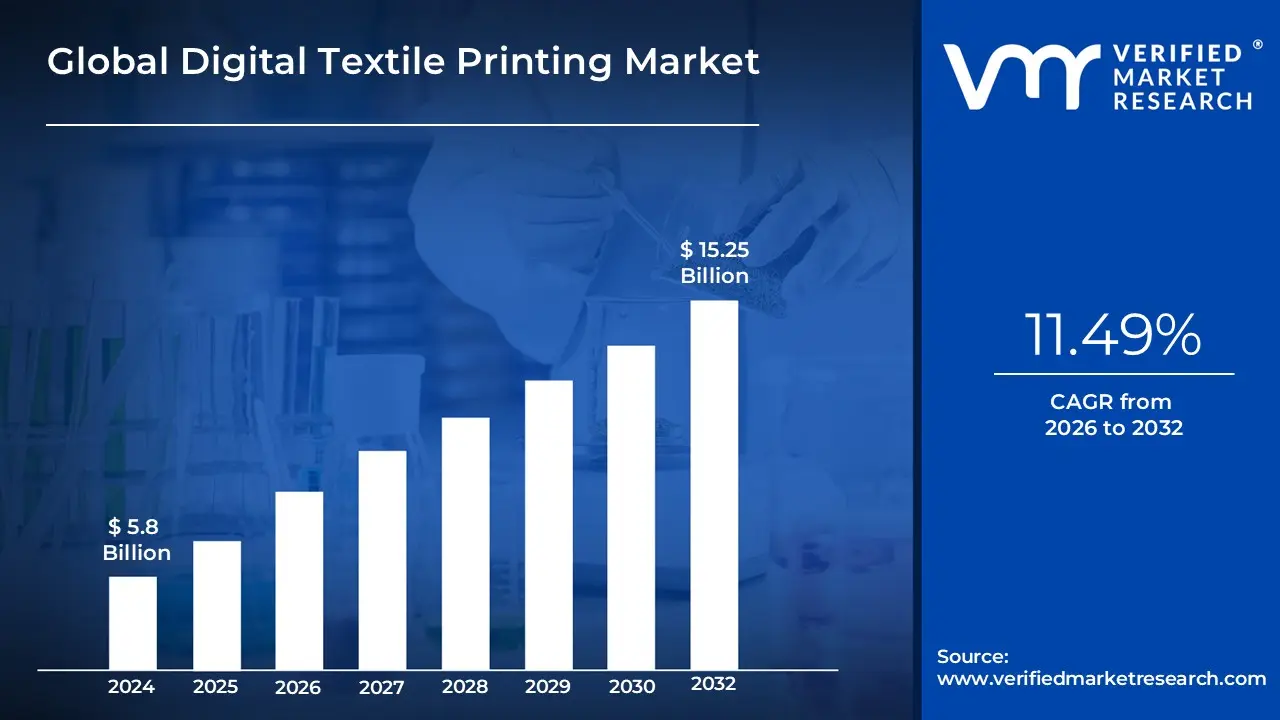 Download a free sample to access exclusive Insights, Data Charts, And Forecasts From The Digital Textile Printing Sample Report
Explore the full Digital Textile Printing Market
Comprehensive TOC Available | Pages: 312 | Tables: 128 | Figures: 94
Digital Textile Printing Market Overview
Market Drivers
1. Shift Toward Mass Customization and Short-Run Production
Digital textile printing technologies are enabling manufacturers to economically produce small batches, customized designs, and rapid seasonal collections without the constraints of traditional screen printing. This capability is strategically transforming supply chain models, allowing brands and textile producers to align production closely with consumer demand while minimizing excess inventory. For enterprise buyers and market research stakeholders, this shift signifies structural changes in procurement patterns, production planning, and vendor selection strategies.
2. Sustainability and Waste Reduction Imperatives
Environmental regulations and corporate sustainability commitments are accelerating the transition from conventional textile printing methods to digital alternatives. Digital printing reduces water consumption, chemical waste, and energy usage, making it increasingly attractive for organizations prioritizing ESG compliance and operational efficiency. From a strategic standpoint, sustainability-driven adoption is influencing capital expenditure decisions and reshaping competitive positioning, particularly for manufacturers targeting environmentally conscious markets.
3. Technological Advancements in Printing Hardware and Inks
Continuous innovation in printhead technologies, ink formulations, and software-driven color management systems is improving print resolution, speed, and substrate compatibility. Enhanced reliability and automation capabilities are lowering operational barriers while increasing scalability for industrial textile applications. For market intelligence users and enterprise decision-makers, these advancements represent critical indicators of long-term technology viability, productivity gains, and cost optimization opportunities.
Download a free sample to access exclusive Insights, Data Charts, And Forecasts From The Digital Textile Printing Sample Report.
Market Restraints
1. High Capital Investment and Integration Costs
Despite operational advantages, digital textile printing systems require significant upfront investment in hardware, RIP software, and workflow infrastructure. Small and mid-sized manufacturers often face financial constraints, delaying technology upgrades or limiting deployment scale. Regionally, cost sensitivity remains a decisive factor in emerging markets, creating adoption disparities and influencing supplier financing strategies.
2. Color Consistency and Process Standardization Challenges
Achieving uniform color reproduction across diverse fabrics, inks, and production environments remains a persistent technical challenge. Variability in substrates and process controls can affect output quality, impacting brand reliability and customer satisfaction. For commercial buyers, these risks necessitate rigorous vendor evaluation, calibration protocols, and quality assurance investments.
3. Skills Gap and Operational Transition Barriers
Successful deployment of digital textile printing requires specialized technical expertise, including color management, maintenance, and software integration. Workforce training requirements and resistance to process change can slow implementation timelines. Strategically, this restraint underscores the importance of service partnerships, technical support ecosystems, and capability development initiatives.
Digital Textile Printing Market Geographical Dominance
North America maintains a dominant position in the Digital Textile Printing Market, supported by early technology adoption, established textile design ecosystems, and strong demand for customized and premium textile products. The United States continues to lead in digital printing investments, driven by fashion, sportswear, and home décor sectors emphasizing rapid prototyping and short production cycles. Europe follows closely, benefiting from stringent environmental regulations, advanced manufacturing capabilities, and innovation-driven textile industries across Germany, Italy, and the United Kingdom. The Asia-Pacific region represents the fastest-growing market, propelled by expanding textile manufacturing bases, rising export-oriented production, and increasing technology penetration in China, India, and Southeast Asia. Emerging markets in Latin America and the Middle East are demonstrating growing interest, particularly in localized apparel manufacturing and interior textile applications.
Digital Textile Printing Market Key Players
Competitive landscape analysis remains critical for understanding technological leadership, pricing dynamics, and strategic alliances within the Digital Textile Printing Market. Prominent market participants include Seiko Epson, Mimaki Engineering ,Kornit Digital, Gen, RolandDG Corporation, Dover Corporation, Konica Minolta, Brother Industries, Colorjet.
Digital Textile Printing Market Segmentation
The Digital Textile Printing Market is segmented based on:
By Printing Process
- Direct To Garment
- Direct To Fabric
By Ink
- Sublimation
- Reactive
- Acid
- Pigment
By End-User
- Clothing
- Households
- Displays
- Technical Textiles
By Geography
- North America
- Europe
- Asia-Pacific
- Latin America
- Middle East & Africa
To gain complete access with Corporate Or Enterprise Licensing, Visit The Digital Textile Printing Market.
Digital Textile Printing Market Strategic Insights
The Digital Textile Printing Market demonstrates strong attractiveness across developed and high-growth regions, supported by favorable technology economics and evolving production models. Entry barriers remain moderate, influenced by capital requirements, intellectual property considerations, and technology vendor dependencies. Pricing strategies are increasingly shaped by ink efficiency, throughput capabilities, and lifecycle maintenance costs. Compliance considerations, particularly environmental standards and chemical usage regulations, are emerging as decisive procurement factors. Strategic partnerships involving hardware vendors, ink suppliers, and software providers are becoming essential for competitive differentiation and operational optimization. Investors and enterprise stakeholders are prioritizing scalable, automation-driven solutions capable of supporting high-mix, low-volume manufacturing environments.
Key Highlights of the Report
- Detailed market size estimation and forecast analysis
- In-depth segmentation and technology assessment
- Regional demand patterns and growth opportunities
- Competitive landscape and vendor benchmarking
- Comprehensive evaluation of drivers, restraints, and risks
Why This Report Matters?
This report provides critical decision-support intelligence for organizations navigating technology investments, capacity planning, and competitive strategy formulation. By integrating quantitative forecasts with qualitative industry analysis, the study enables stakeholders to identify growth avenues, mitigate risks, and optimize resource allocation. The insights are particularly relevant for enterprises seeking sustainable production models and digitally enabled manufacturing capabilities.
Who Should Read This Report?
- Market research and strategy professionals
- Textile and printing technology manufacturers
- Enterprise procurement and investment decision-makers
- Investors, consultants, and industry analysts
Related Reports
Global Digital Inks Market Size By Formulation Type (Solvent-Based Digital Inks, UV-Cured Digital Inks, Water-Based Digital Inks, Dye-Based Digital Inks, Pigment-Based Digital Inks), By Substrate (Paper, Textiles, Plastics, Ceramics, Glass), By Application (Textile Printing, Packaging, Commercial Printing, Advertising and Promotion), By Geographic Scope And Forecast
Global Digital Textile Printing Inks Market Size By Ink Type, By Application, By Geographic Scope And Forecast
Global Direct Thermal Inks and Coatings Market Size By Ink Type (Wax-Based Inks, Resin-Based Inks, Wax-Resin Based Inks), By Application (Labelling & Packaging, Textile Printing), By End-User (Retail, Healthcare, Manufacturing, Logistics and Transportation), By Geographic Scope and Forecast
Global Dye Sublimation Paper Market Size By Type of Dye Sublimation Paper (Standard Dye Sublimation Paper, Tacky Dye Sublimation Paper, High-Release Dye Sublimation Paper), Application (Textile Printing, Industrial Printing, Ceramic Printing), Distribution Channel (Online Retail, Offline Retail, Direct Sales), & Region for 2024-2031
Top 7 Digital Textile Printing Companies blending technology and creativity together
Visualize Digital Textile Printing Market using Verified Market Intelligence -:
Verified Market Intelligence is our BI Enabled Platform for narrative storytelling in this market. VMI offers in-depth forecasted trends and accurate Insights on over 20,000+ emerging & niche markets, helping you make critical revenue-impacting decisions for a brilliant future.
VMI provides a holistic overview and global competitive landscape with respect to Region, Country, Segment, and Key players of your market. Present your Market Report & findings with an inbuilt presentation feature saving over 70% of your time and resources for Investor, Sales & Marketing, R&D, and Product Development pitches. VMI enables data delivery In Excel and Interactive PDF formats with over 15+ Key Market Indicators for your market.
About Us
Verified Market Research® stands at the forefront as a global leader in Research and Consulting, offering unparalleled analytical research solutions that empower organizations with the insights needed for critical business decisions. Celebrating 10+ years of service, VMR has been instrumental in providing founders and companies with precise, up-to-date research data.
With a team of 500+ Analysts and subject matter experts, VMR leverages internationally recognized research methodologies for data collection and analyses, covering over 15,000 high impact and niche markets. This robust team ensures data integrity and offers insights that are both informative and actionable, tailored to the strategic needs of businesses across various industries.
VMR's domain expertise is recognized across 14 key industries, including Semiconductor & Electronics, Healthcare & Pharmaceuticals, Energy, Technology, Automobiles, Defense, Mining, Manufacturing, Retail, and Agriculture & Food. In-depth market analysis cover over 52 countries, with advanced data collection methods and sophisticated research techniques being utilized. This approach allows for actionable insights to be furnished by seasoned analysts, equipping clients with the essential knowledge necessary for critical revenue decisions across these varied and vital industries.
Verified Market Research® is also a member of ESOMAR, an organization renowned for setting the benchmark in ethical and professional standards in market research. This affiliation highlights VMR's dedication to conducting research with integrity and reliability, ensuring that the insights offered are not only valuable but also ethically sourced and respected worldwide.
Follow Us On: LinkedIn | Twitter | Threads | Instagram | Facebook

Mr. Edwyne Fernandes

Verified Market Research®

US: +1 (650)-781-4080

US Toll Free: +1 (800)-782-1768

Email: sales@verifiedmarketresearch.com

Web: https://www.verifiedmarketresearch.com/

SOURCE – Verified Market Research®